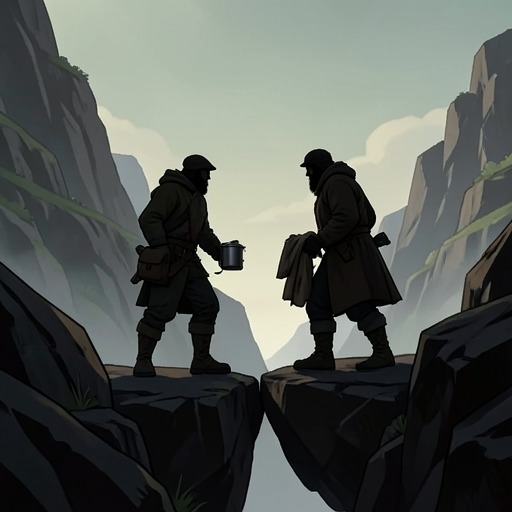
Anarres as a mining colony
The DispossessedAnarres as a mining colony is the material contradiction at the heart of the planet’s claimed independence. Eight times a year, Urrasti freighters carry away Anarres’s minerals and bring back goods its economy cannot readily produce; the bargain sustains the settlement while leaving it exposed to the power and market logic it rejects. Shevek’s empty-handed arrival on Urras and his later offer to share his scientific work turn that contradiction into a question of exchange: whether dependence must mean submission, or whether a different kind of giving can open a way through isolation.
The Trade and Its Unequal Cargo
The freighters from Urras arrive only eight times a year and stay just long enough to load and unload. Their incoming cargo includes fossil oils and petroleum products, delicate machine parts, electronic components, and sometimes new strains of fruit trees or grain for testing. In return, they take mercury, copper, aluminum, uranium, tin, and gold. The ships’ regular traffic links Anarres’s everyday material needs to the extraction of its mineral wealth, even though the two worlds otherwise remain sharply separated.
The trade is highly profitable for Urras. Cargo division is among the most prestigious functions of the Council of World Governments and a major event in the Urrasti stock market. From the Anarresti perspective, the same traffic makes the planet a mining colony: its resources flow outward in a bargain whose terms are shaped by a more powerful, propertarian world. The language of commerce does not erase the asymmetry; it gives that asymmetry a routine, recurring form.
The Bargain Behind Isolation
The arrangement is contested in Anarres’s political debates. Protests ask why the planet continues profiteering transactions with warmaking propertarians, while the answer offered by more cautious voices is strategic: Urras finds it cheaper to buy the ores than to mine them itself, and ending the agreement could provoke an invasion. The calculation is difficult for people who have never paid money for anything to understand, but it describes the price attached to Anarres’s security. Seven generations of peace have not produced trust.
That dependence also shapes the work assigned to Defense. Its workers maintain twelve old interplanetary ships, radar and radio-telescopic scans, and dull duties at the Port; the work is drudgery, yet it attracts volunteers through the romance of watchfulness, danger, and spaceships. The Port embodies both the practical limits of Anarresti self-sufficiency and the imaginative pull of the world beyond it. Shevek, disappointed when he fails to see an ore freighter departing, experiences that pull as youthful romance, while the wider account gives the same ships a harsher economic meaning.
Shevek’s Empty Hands
Shevek carries the logic of Anarresti non-ownership into his arrival on Urras. When his luggage is missing, he explains that he brought nothing: in a society where people buy things, he cannot purchase food or bring enough of it with him. If his hosts keep him alive, he says, they must give him what he needs. Calling himself the Beggarman, he makes his dependence plain while asking his hosts to behave according to the practice of giving rather than selling.
Later, when Saio Pae has arranged for a servant to bring him a few necessities, Shevek again describes himself as the Beggarman, arriving with empty hands like a good Odonian. The contrast is pointed: on Anarres, he has not brought money or gifts because money is unused and his own society does not possess what Urras lacks; on Urras, where things are bought, accepting hospitality exposes the economic difference between them. The phrase does not conceal his need. It makes the terms of the encounter visible and frames receiving as a social relation rather than a private purchase.
Bargaining, Refusal, and the Gift
Shevek does not mistake his position for freedom from Urras’s market power. When Chifoilisk warns him that he is a child among thieves and that Urras’s welcome is tied to a profit economy, Shevek answers that he came to bargain with it. What he seeks is not personal wealth but an end to the exile between the worlds: free exchange between Urras and Anarres, human solidarity, and the removal of the walls that keep them apart. He sees his work on Anarres and his presence on Urras as different forms of action toward that purpose.
His eventual alternative to selling is explicitly a gift. Shevek wants to give his theory not just to one government but to Urras, Hain, and the other worlds, so that no single power can turn it into a private instrument of wealth, military advantage, or domination. The choice answers the extraction embodied by the freighters with a different model of circulation: knowledge made common rather than enclosed for profit. Shevek refuses to wait for truth to serve the common good eventually; he insists that the means of sharing matter in his own lifetime.
A Dependent Independence
The mining-colony condition is more than a trade statistic. It shows how Anarres’s isolation from Urras coexists with material connection: the planets are politically estranged, but fuels, components, food-growing stock, and minerals cross the boundary on a schedule. That connection preserves a fragile peace while reproducing the imbalance that makes Anarres vulnerable. The language of independence therefore sits beside the evidence of dependence, and neither cancels the other.
The wider story gives that boundary a physical and political force. During wartime on Urras, research can be classified, publication delayed, and travel restricted, with Shevek’s movement beyond the university campus made subject to clearance. Later, the Terran embassy’s claim that its castle is Terran soil offers him a diplomatic refuge within Urras, while the closure terms discussed back on Anarres forbid people arriving from Urras to leave the freight ships beyond the Port boundary. These moments do not make the trade disappear; they show how movement, knowledge, and access are governed around it. Against that system, Shevek’s gift proposes a relation between worlds not founded on ownership, enforced isolation, or a bargain in which one side’s resources become the other’s profit.